
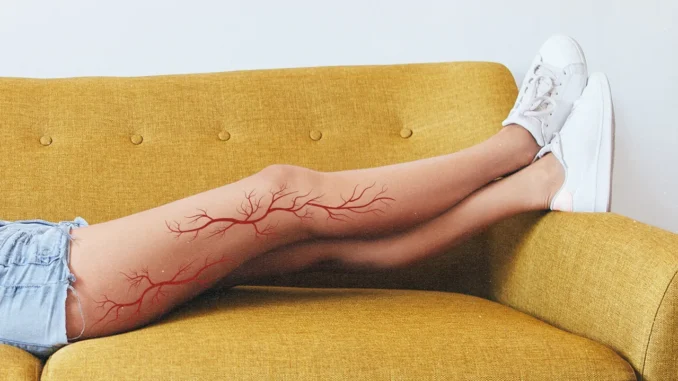
Spider veins on the legs are a problem faced by many women after age 25. Men are less likely to experience this. Spider veins appear as a thin red or blue mesh on the skin, but this “pattern” conceals serious problems with the venous system. Let’s explore why this problem occurs, how to treat it, and how to avoid it.
Table of Contents
What are spider veins?
Spider veins, or telangiectasias, are dilated small blood vessels located close to the skin’s surface. They most often appear as a “spiderweb”-like pattern of red, blue, or purple color.
Telangiectasias can be seen on the thighs, shins, or feet. Spider veins are not only unsightly but also often indicate the onset of chronic venous insufficiency or varicose veins.
In everyday life, a network of small vessels is sometimes called “couperose on the legs,” and on the face, simply rosacea. When it comes to the lower extremities, it’s most often referred to as telangiectasias and the initial signs of venous insufficiency.
Cosmetic defect or medical problem?
For many patients, spider veins on the legs become purely a matter of aesthetics. Telangiectasias make the skin appear less smooth and uneven, forcing patients to avoid revealing clothing or shoes. Phlebologists insist that the appearance of spider veins can be the first sign of venous insufficiency or a signal of the early stages of varicose veins.
It is important to clearly understand the difference:
-
A cosmetic defect is a single spider vein that is not accompanied by swelling, heaviness, or pain in the legs. In this case, telangiectasias are removed primarily for aesthetic reasons.
-
A medical problem is spider veins, which cause significant discomfort and lead to the formation of varicose veins. In this situation, you should consult a phlebologist.
Specialist assistance not only helps eliminate unsightly external manifestations, but also prevents serious complications that can develop when the condition is left untreated.
The importance of timely diagnosis
Don’t ignore the appearance of spider veins. Even if they don’t cause discomfort, telangiectasias may indicate weakened vessel walls and impaired venous blood flow. Without treatment, the problem worsens, and small spider veins can develop into varicose veins.
Early diagnosis helps determine the cause of spider veins on the legs. The cause may be a hereditary predisposition, hormonal changes, or early venous insufficiency. A consultation with a phlebologist and a thorough examination will help determine the right approach—from conservative treatment to modern methods for removing telangiectasias.
Causes of spider veins
The appearance of telangiectasias is a clear sign of a problem with the venous system. Sometimes they appear due to temporary factors, but more often they indicate chronic problems. Let’s look at the typical causes in more detail.
Hormonal changes
Telangiectasias most often first appear in women during periods of hormonal changes. This occurs during pregnancy, while taking oral contraceptives, or during menopause. Hormonal fluctuations weaken the vessel walls and make them more vulnerable.
Hereditary predisposition
The structure of venous valves and the elasticity of blood vessels are largely determined by genetics. If parents or close relatives have been diagnosed with varicose veins, there’s a high chance the patient will also develop spider veins on their legs.
Long-term loads
Jobs that require constant standing—such as those of teachers, hairdressers, doctors, and salespeople—as well as intense exercise, increase blood pressure in the lower extremities. This results in the formation of spider veins on the skin.
Varicose veins
Spider veins are often the first symptom of developing varicose veins. Impaired blood flow and venous insufficiency lead to dilated capillaries, which become visible on the skin’s surface.
Bad habits
Smoking and alcohol abuse negatively impact vascular tone. Gradually, capillaries lose their ability to contract, and telangiectasias appear on the legs. Other bad habits include excessive sauna use and excessive hot bathing.
Types of vascular networks
Although all telangiectasias are commonly referred to by the same name, doctors distinguish several types of spider veins. Understanding their characteristics helps a phlebologist choose the optimal treatment.
Capillary networks
They appear as a thin red or blue mesh, most often located in the upper layer of the skin. They are usually perceived as a cosmetic defect, but may indicate the onset of microcirculation problems or hormonal changes.
Spider veins
These are large, easily visible purple or dark blue stars that merge into a pattern. They form when small veins dilate and often accompany varicose veins. The appearance of spider veins requires consultation with a specialist and a thorough examination of the veins.
Localization
Telangiectasias most often appear on the thighs, shins, and ankles. They sometimes occur on the feet, where the skin is thin and sensitive. The location of the spider veins can also help determine the cause. For example, in women, the shins are more often affected during pregnancy.
Which doctor should I see and when?
A phlebologist is the first specialist you should consult if you notice spider veins on your legs. They will assess whether the telangiectasia is merely a cosmetic issue or indicates venous insufficiency. They will then recommend a solution—observation, conservative treatment, or removal.
What symptoms are important to pay attention to:
-
a feeling of heaviness that intensifies towards evening;
-
swelling of the legs or ankles;
-
night cramps in the calf muscles;
-
burning, itching, increased skin sensitivity;
-
strengthening of varicose veins, appearance of bulging veins;
-
skin discoloration, pigmentation, dryness, microcracks.
Risk of developing varicose veins
If the condition progresses, the patient experiences pain, swelling, and fatigue, increasing the risk of developing varicose veins. It’s important not to wait for it to “go away on its own.” Without addressing risk factors—physical inactivity, excess weight, prolonged static loads—and without proper treatment, the situation typically slowly worsens.
What is included in the diagnostics?
The basic minimum is a consultation with a phlebologist and a duplex ultrasound scan of the veins. This examination allows:
-
to assess the patency and valve function of the superficial and deep veins;
-
identify reflux – reverse blood flow;
-
determine whether spider veins are associated with impaired venous outflow.
Based on the results of the examination, the doctor develops a personal plan – from adherence to preventive measures to surgical intervention.
In some cases, the patient requires immediate assistance. These include:
-
sudden appearance of multiple mesh;
-
rapid increase in the affected area;
-
severe pain, swelling, compaction;
-
trophic changes in the skin.
Spider veins on the legs: treatment
Medicine uses various methods to remove spider veins. The choice depends on the cause of the spider veins, the condition of the veins, and the patient’s individual characteristics.
Hardware techniques
Laser removal
This is a modern correction method popular among patients. The procedure involves applying a laser beam to the damaged vessel, causing it to “glue” together and become invisible.
The beam acts selectively, without damaging surrounding tissue. After several sessions, varicose veins become virtually invisible, and the patient can return to their normal lifestyle.
Sclerotherapy
One of the most reliable methods for removing spider veins on the legs. During sclerotherapy, a special drug called a sclerosant is injected into the vessel. It causes the walls to stick together and stop blood flow. Over time, the spider veins disappear.
Sclerotherapy is suitable for treating severe telangiectasias. With proper preventative measures, the results are long-lasting.
RF-lifting (radiofrequency coagulation)
The technique is based on heating the blood vessel with a radiofrequency pulse. It’s a minimally invasive procedure that takes 15–20 minutes. It’s suitable for patients with thin skin, for whom laser treatment may be undesirable. It provides rapid cosmetic results.
Conservative treatment methods
Sometimes, removal of spider veins on the legs is not necessary, and supportive therapy is sufficient. In the early stages, the following are indicated:
-
Compression hosiery. Wearing it improves blood flow and reduces the risk of venous insufficiency progression.
-
Ointments and creams. Popular options include Troxevasin, Lyoton, and Venitan. They help reduce swelling and relieve heaviness and fatigue in the legs.
-
Physical activity. Special exercises stimulate venous outflow and strengthen blood vessels.
-
Massage and hydrotherapy. Light lymphatic drainage massage and contrast showers improve microcirculation.
It should be noted that conservative methods do not help to remove telangiectasias that have already appeared, but rather slow the development of the pathology and enhance the effect of hardware procedures.
Common myths about spider veins
Telangiectasias are associated with numerous misconceptions. Many patients put off seeing a doctor, relying on online advice or folk remedies. Let’s debunk the most common myths.
Myth 1: Spider veins can disappear on their own.
Telangiectasias do not resolve without medical intervention. If the underlying cause is not addressed, the spider veins will only increase in size, and over time, varicose veins may develop.
Myth 2: Only surgery will help.
Minimally invasive procedures such as laser removal, sclerotherapy, and RF coagulation help get rid of spider veins. These methods do not require anesthesia, are performed on an outpatient basis, and allow a quick return to normal life.
Myth 3: Ointments and creams completely eliminate telangiectasias
Over-the-counter medications can improve skin condition and relieve swelling and heaviness, but they won’t restore damaged blood vessels. For lasting results, hardware-based techniques are necessary.
Myth 4: This is only a cosmetic defect, so no treatment is required.
Although spider veins are often perceived as an aesthetic concern, they can be a sign of venous insufficiency. Ignoring the symptoms increases the risk of developing varicose veins and thrombophlebitis.
Myth 5: Removing spider veins is dangerous.
The methods used in modern medicine are safe and effective. Procedures are performed using innovative equipment, eliminating the risk of complications.
Prevention of spider veins
Preventative measures can help reduce the risk of spider veins or slow their progression. Prevention is especially important if the patient has a predisposition to venous disease. Let’s explore the measures that can help protect against telangiectasias.
Weight control and healthy eating
Excess weight increases stress on the legs and contributes to varicose veins. A diet should be rich in fiber, such as vegetables, fruits, and grains. Nuts, fish, green tea, and citrus fruits are also beneficial, as they strengthen blood vessel walls.
Regular physical activity
Daily walks and light cardio stimulate circulation in the legs. Specific exercises for the calves and feet (calf raises, foot rotations) improve venous function. It is recommended to avoid prolonged sitting or standing still; take breaks every 1–2 hours.
The right choice of clothes and shoes
Jeans that are too tight, tight pantyhose and stockings, and high-heeled shoes can impair blood flow. Clothing should be loose enough. Shoes with a stable heel of up to 5 cm and a comfortable fit are ideal. If you sit for long periods, you can wear compression socks or stockings, as recommended by your doctor.
Hormonal control
Pregnancy, contraceptive use, and menopause increase the risk of varicose veins. Regular checkups with a gynecologist or endocrinologist will help correct hormonal imbalances promptly.
Giving up bad habits
Smoking and excessive alcohol consumption worsen the condition of blood vessels and reduce their elasticity. It is recommended to give up these bad habits and lead an active lifestyle, eliminating stress factors that increase venous pressure.
Regular check-ups with a phlebologist
Even if spider veins don’t bother you, a yearly checkup helps detect venous insufficiency early. Modern diagnostic methods (venous ultrasound, duplex scanning) allow for painless and non-invasive assessment of vascular health.
Conclusion
Spider veins on the legs are not only a cosmetic concern but also a sign of poor venous circulation. Systematic prevention, a healthy lifestyle, and regular screenings can help reduce the risk of developing telangiectasias.
Don’t ignore alarming symptoms; take action immediately. The sooner treatment begins, the more effective it will be. For example, at the Medical Star clinic, specialists will help restore the beauty and health of your legs using safe, modern techniques.
We know how to remove spider veins on your legs using a comprehensive treatment approach. All procedures are minimally invasive, effective, and extremely safe for the patient.
Remember: varicose veins and spider veins are not a life sentence. Modern technologies can not only eliminate visible signs but also ensure healthy veins. Schedule a consultation today to receive a personalized treatment and prevention program for spider veins.
